


What your property is actually competing with
There is no single Summit County market. There is a handful of properties a buyer would seriously consider instead of yours, and that number changes how long you sit.
Written by Tucker Zimmerman, Summit County Realtor with Slifer Smith & Frampton
There is no Summit County market. When a headline says the county median went up or down, it is blending a Breckenridge ski-in condo, a Silverthorne townhome and a Blue River house. Your buyer is not shopping that blend. They are choosing between your property and a handful of others that are close enough to be interchangeable with it.
That handful is your actual market, and it is knowable.
How to find your real competitive set
Keep narrowing until you get to properties a buyer would seriously consider instead of yours.
- Start with the county, which is where most market reports stop.
- Narrow to the town or resort area.
- Narrow to the neighborhood or the specific complex.
- Narrow to the property type, because a condo and a house are different products.
- Narrow to a price range a buyer would actually cross-shop, usually within about 20%.
- Narrow to bedroom count and rough size.
What is left is usually somewhere between two and twenty properties. That is what you are competing with. Not the 400 active listings in the county.
Your competition is not every home in Summit County. It is whatever a buyer might reasonably buy instead of yours, and if your agent cannot name those properties specifically, they have not done the work.
What competition actually costs you
For every listing since 2015, I counted how many close substitutes were already on the market the day it went live. Same area, same property type, within one bedroom and within 20% on price. Then I looked at what happened next.
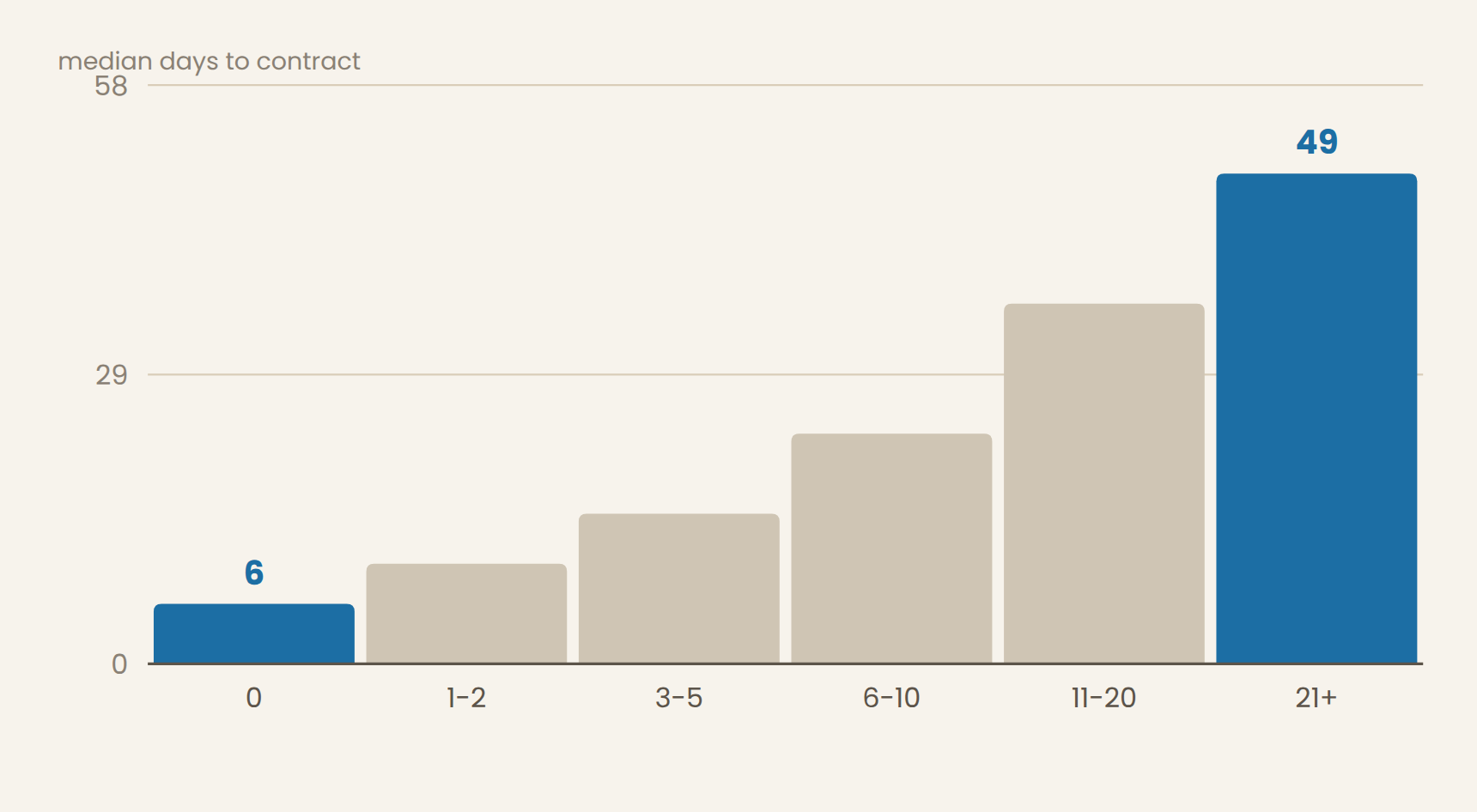
| Competing listings | Median days to contract | Listings |
|---|---|---|
| 0 | 6 | 2,118 |
| 1-2 | 10 | 3,602 |
| 3-5 | 15 | 4,026 |
| 6-10 | 23 | 4,364 |
| 11-20 | 36 | 4,389 |
| 21+ | 49 | 3,089 |
A listing with nothing else like it available went under contract in a median six days. A listing with twenty-one or more close substitutes took about forty-nine. That relationship held after controlling for property type, area, price, size and year.
The part that surprised me
Competition costs you time. Among properties that sold, it did not show up in the final price.
I expected crowded listings to sell for less. They did not. The effect of competition on the final sale price was statistically indistinguishable from zero, and the confidence interval around it was tight enough that I am fairly confident there is no meaningful effect hiding in there.
What competition did do, reliably, was slow things down and raise the odds of a price reduction along the way. So the honest framing is that a crowded shelf is a tax on your timeline and on your patience, not on your eventual number, assuming you price correctly to begin with and are willing to wait.
This is one of the findings I would have quietly dropped if I were trying to build a sales pitch. It cuts against the usual line about needing to price aggressively because of competition. The data did not support that, so here it is.
Some property types feel competition far more than others
This is the part with real practical value. The same number of competing listings does not hurt every property equally, and the spread is large.
| Property type | Added time per competing listing | What that means |
|---|---|---|
| Duplex | about 8.3% | The most interchangeable product in the county |
| Townhouse | about 4.4% | Units repeat, so buyers compare directly |
| Condo | about 3.0% | Depends heavily on how much the units vary within a complex |
| Single family | about 1.2% | Every house is a little different, which insulates it |
A sevenfold spread between duplex and single family. If you own something that repeats, like one of forty nearly identical units in a complex, competition is close to the whole game and timing your launch matters enormously. If you own something unusual, you have more freedom to ignore what else is listed.
What to do with this
- Count your competitors before you set a price. Not the county inventory. Yours.
- If the shelf is crowded, plan for a longer timeline rather than a lower price. That is what the data supports.
- If your property repeats, launch when the shelf is thin. For a repeating unit this is one of the few levers with a measurable effect.
- Know where you win and where you lose. Every property loses somewhere. The ones that sell belong to sellers who knew the weakness in advance and either fixed it or priced for it.
Competition also explains part of why June is such a crowded month to list, though not all of it. It accounted for roughly half of the extra time June listings took to go under contract, and none of the price difference. The timing page covers the rest.
Common questions
Usually between two and twenty, not the several hundred active listings countywide. Your real competitive set is properties in the same area and of the same type, within roughly one bedroom and 20% on price.
The data does not support that. More competing listings clearly slowed sales down and raised the odds of a price reduction, but the effect on final sale price was indistinguishable from zero. Competition costs time rather than price.
It depends heavily on competition. Listings with no close substitutes on the market went under contract in a median six days. Listings facing twenty-one or more similar properties took about forty-nine days.
No. Each additional competing listing was associated with roughly 8.3% more time for a duplex, 4.4% for a townhouse, 3.0% for a condo and 1.2% for a single family home. Interchangeable properties feel competition far more.
Worksheets you can print
Free printable worksheets from this section. No email required.
Where to go next
If you would rather just talk it through
If you want to know what your specific property is competing with right now, I can pull the actual list and walk through where you win and where you lose. That takes about twenty minutes and it is the most useful thing I can do before anyone talks about price.
You can see how I work with sellers, request a property value review, or just call. I do not run a hard follow up sequence, and I am fine with a conversation that ends in you deciding not to sell.
Associate Broker, Slifer Smith & Frampton Real Estate. Based in Frisco, working across Summit County.
(303) 907-9129 · TZimmerman@SliferSummit.com · Contact page
Back to the Seller Playbook · about Tucker · Summit County homes for sale
How I ran this, sample sizes, and what the data did not show (optional, for the skeptical)
Most readers can skip this. It is here so anyone who wants to check my work can.
Every residential listing in the Summit MLS from 2015 through early 2026, across Breckenridge, Frisco, Silverthorne, Dillon, Keystone, Copper Mountain, Blue River, Wildernest, Heeney, Summit Cove and Montezuma. About 26,000 records before cleaning, 25,230 after. Single family, condo, townhouse and duplex. Pulled as record level MLS exports, not from aggregate reports. Every price finding on this page is computed only on the 19,610 listings that sold. The 5,371 that expired or were withdrawn have no sale price, so they sit outside those numbers.
For each listing I counted the properties that were active on the MLS on the day it went live, in the same area, of the same property subtype, within one bedroom, and within 20% of its original list price. That definition is a judgment call. Widening or narrowing the bands changes the magnitudes but not the direction of any finding here.
Days to contract was modeled on a log scale with fixed effects for area, property type, price band and listing year, so the competition effect is measured within comparable groups rather than across them. The per-type figures come from separate models fit within each property type.
- The MLS shifted from coding failed listings as withdrawn to coding them as expired around 2020. The two are always combined here.
- Summit County transaction counts are small. A handful of high priced closings can move a countywide median. Where a cell was too thin to say anything, I left it out rather than publishing it.
- Everything here is observational. Sellers choose when to list, what to fix and what to ask, and those choices are not random. These are patterns in what happened, not proof of what causes what.
- Competing listings are counted at the moment a property goes live. A property that sat for months faced a competitive set that changed the whole time, which this measure does not capture.
Reporting only the findings that worked would make this an advertisement. These did not:
- Competition does not move price. The estimated effect on sale price was +0.0003 percentage points per competing listing, with a confidence interval running from about -0.011 to +0.012. That is a tightly bounded zero rather than an inconclusive result, which is why I am willing to state it as a finding rather than a shrug.
- Competition explains time, not the seasonal price gap. It accounted for roughly 46% of the extra days June listings took to go under contract and none of the June price difference, so something other than a crowded shelf is driving the price side.
Analysis run August 2026 on listings through early 2026. Current conditions are deliberately not in these pages. Information is deemed reliable but not guaranteed. This is general information about market patterns, not advice about your specific property, and nothing here is legal or tax advice.