


Summit County Real Estate / Short-Term Rental Guide
2026 Unincorporated Summit County Short-Term Rental Rules
Unincorporated Summit County has the most complex STR framework in the region. Your property's rules depend on which overlay zone it sits in, and within the residential zone, which of four drainage basins. The mailing address tells you almost nothing. Wildernest has a Silverthorne address but is not Silverthorne. Dillon Valley has a Dillon address but is not Dillon. Getting this wrong before you make an offer is an avoidable and expensive mistake.
Written by Tucker Zimmerman, Associate Broker, Slifer Smith & Frampton — Summit County, Colorado
303-907-9129 | TZimmerman@SliferSummit.com
Updated July 2026
A Word About Summit County's Published STR Information
I'll be direct: Summit County's published STR information is a mess. The county's regulations page shows cap numbers that imply licenses are available in basins where no new applications are being accepted. The waitlist documents are updated once a year while the county issues licenses from those same waitlists on a rolling basis throughout the year. The published numbers and the actual situation do not match, and there is no single page on the county's website that reconciles them.
I monitor this program closely and I still can't get a reliable current answer from the county's website alone. If STR eligibility matters to your purchase, do not rely on what you read on the county's site -- including the basin numbers on this page, which reflect the last official January 2026 update. Call me before you make any decisions. I know which questions to ask and how to get a real answer. 303-907-9129 or TZimmerman@SliferSummit.com
Step One: Confirm the Property Is Actually in Unincorporated Summit County
Before any of the basin or overlay zone analysis applies, you need to confirm the property is in unincorporated Summit County rather than inside an incorporated town. If it is inside a town, that town's rules apply instead. A Breckenridge address does not mean Breckenridge rules. A Dillon address does not mean Dillon rules. A Silverthorne address does not mean Silverthorne rules.
Use the Summit County GIS Parcel Query Tool. Enter the address and check the Jurisdiction field. If it says unincorporated Summit County, this page applies. If it names a town, go to that town's STR page instead.
The Two Overlay Zones: Very Different Situations
Summit County divides all unincorporated land into two overlay zones. Which zone a property sits in determines everything about the STR path.
No Cap — No Waitlist
Resort Overlay Zone (ROZ)No cap on licenses. No limit on rental nights. 100% of properties eligible. Apply after closing through the Summit County Host Compliance portal. Areas in the Resort Overlay Zone:
License fee: $250/year. Expires May 31. Renewed in September. |
All Basins Capped or Over Cap — Waitlists Active
Neighborhood Overlay Zone (NOZ)Divided into four drainage basins, each with a hard cap on Type II licenses. All four basins are currently at or over their caps. No new Type II licenses are being issued. Waitlists are active for all four basins. Additional restrictions in the NOZ:
Type II license fee: $360/year. Expires May 31. Renewed in September. |
Need help determining which zone and basin a specific property falls in? I verify this on every STR-focused purchase before any offer goes in. 303-907-9129 or TZimmerman@SliferSummit.com
Type I Exception License: Who Can Get One and How It Works
The Type I license exists because Summit County wanted to incentivize local workforce housing, not just restrict short-term rentals. The idea is simple: if a local worker is living on the property, the county treats the STR activity differently and does not count it against the basin cap. It is available even when basins are full and waitlists are active.
It sounds appealing. In practice, most out-of-area investment buyers cannot satisfy the requirements. Here is exactly what the county requires:
The Qualified Occupant Requirements
The Qualified Occupant (QO) must satisfy ALL of the following simultaneously:
- Summit County mailing address: The QO must have a Summit County mailing address as their primary residence.
- Lives on the property: The QO must reside at the STR property for at least 9 months per year.
- Works in Summit County: The QO must work at least 30 hours per week in Summit County. Pay stubs, W-2s, or other employment documentation required.
- Motor vehicle registration: Required as part of the application documentation.
Who the Qualified Occupant Can Be
This is where it gets more flexible than most buyers realize. The Qualified Occupant does not have to be the property owner. It can be:
- The owner, if they live and work in Summit County full time
- A long-term renter who lives on the property and works in Summit County
- A local workforce retiree who meets the primary residency requirement
- A self-employed individual who works in Summit County 30+ hours per week
The renter path is worth understanding
If you own a property in a capped NOZ basin and rent it long-term to a Summit County worker who lives there full time and works 30+ hours a week locally, that tenant can qualify as the Qualified Occupant. You could then obtain a Type I license and rent the property short-term during periods when the tenant is away or not occupying it. This is a narrower use case than it sounds in practice, but it is a real path for some owners in the right circumstances.
Lockoffs, garage apartments, and basement studios
One scenario where the Type I path comes up in real purchases: a single-family home with a lockoff unit, an above-garage apartment, or a basement studio. If that secondary space qualifies as an Accessory Dwelling Unit (ADU) under Summit County's land use code, and a qualified local worker lives there full time and works 30+ hours per week in Summit County, the owner may be able to obtain a Type I license and rent the primary home short-term during periods they are away.
Whether a specific space qualifies as an ADU under the county code, and whether it satisfies the covenant requirements attached to a Type I license, needs to be verified directly with Summit County Community Development before purchasing with this strategy in mind. Do not assume a basement bedroom, an informal studio, or an unlicensed lockoff qualifies. Get confirmation from the county first.
Key Operating Restrictions Under a Type I License
- The 35-booking-per-year limit still applies, same as Type II.
- The Qualified Occupant must remain in residence for 9+ months per year for the license to remain valid.
- If the QO stops meeting the requirements, the Type I license is no longer valid and you cannot convert to a Type II in a capped basin.
- Type I licenses are not counted toward basin caps and there is no limit on how many are issued.
- Annual fee: same as Type II at $360/year. Renewed in September.
Bottom line: Type I is a legitimate path for owners who live full time in Summit County, owners willing to house a full-time local worker, or retirees who make the property their primary Summit County residence. For most out-of-state second-home buyers, it is not a realistic option.
Source: Summit County: Short-Term Rental FAQs | Summit County: License Applications
Copper Mountain Is Technically Unincorporated Summit County — But a Different Story Entirely
Copper Mountain sits in unincorporated Summit County, which is why it appears in this guide. But it is in the Resort Overlay Zone, not the Neighborhood Overlay Zone. None of the basin caps, Type I versus Type II distinctions, or 35-booking limits apply. Copper Mountain has no cap, no waitlist, no booking limit, and 100% of properties are eligible for a Resort license.
If you are evaluating Copper Mountain specifically, the full licensing picture lives on its own page: Copper Mountain Short-Term Rental Rules.
The Four Neighborhood Overlay Zone Basins
Each basin is named after its primary water drainage. Cap numbers and current license counts are updated by Summit County once per year, in January. The figures below reflect the January 2026 official update.
As documented above, Summit County issues licenses from these waitlists on a rolling basis throughout the year but does not update its public documents to reflect that activity. The numbers below represent the last official snapshot, not the current state. Verify directly with the county before any purchase decision.
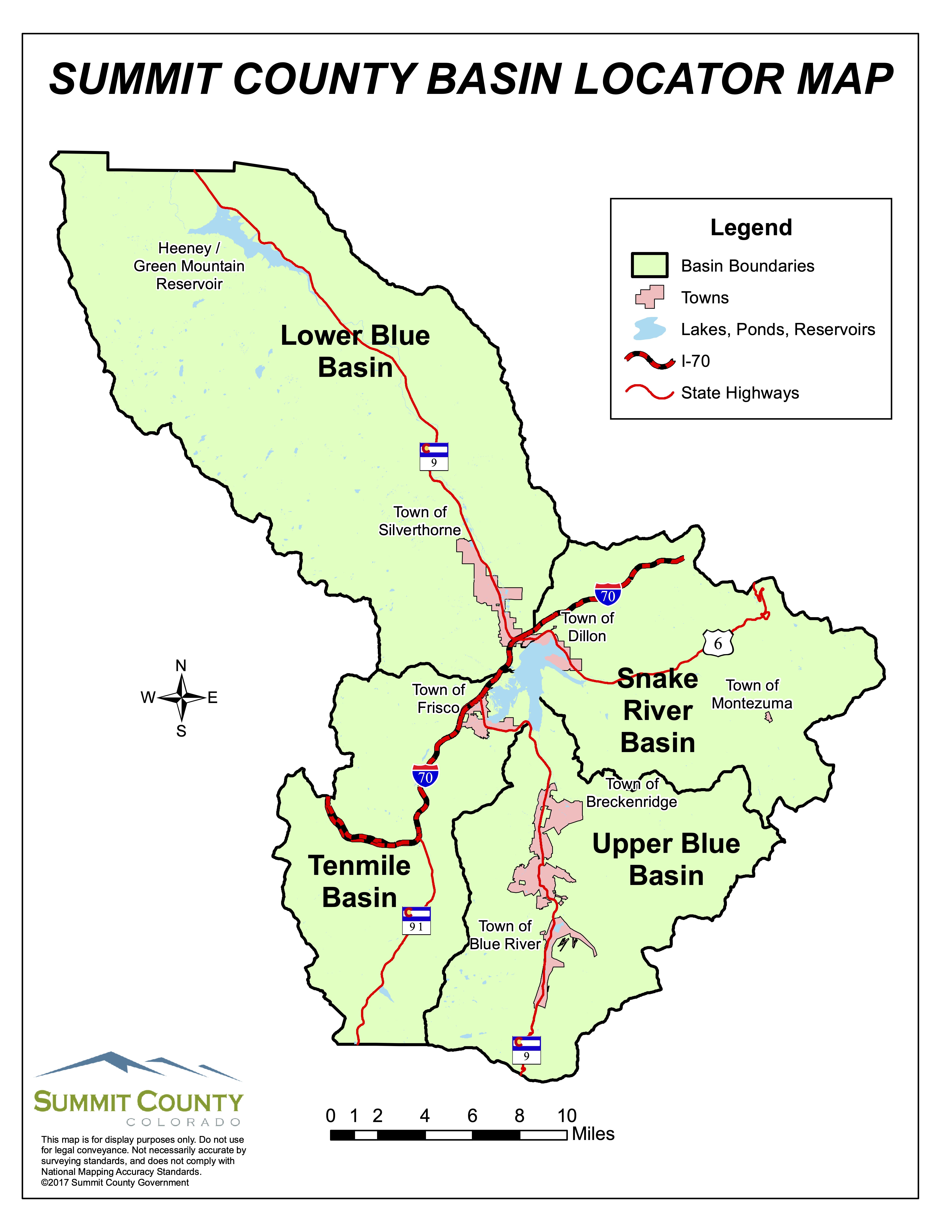
Summit County Neighborhood Overlay Zone basin boundaries. Use the Summit County Basin Locator Map to confirm any specific property address.
Lower Blue BasinCap: 550 Type II licenses | Issued: 508 (Jan 2026) | Status: Waitlist active. No new Type II applications accepted. Waitlist $75 non-refundable fee. Only property owners may apply. Neighborhoods in this basin:
|
Buyer reality The January 2026 waitlist showed 101 addresses in queue. The county's published numbers are updated once a year and do not reflect licenses issued since then. Current queue length and wait time: call Summit County directly at 970-668-4186. |
Important: Wildernest listings routinely show "Silverthorne" as the city. That is the mailing address, not the jurisdiction. These properties follow Summit County rules, not Town of Silverthorne rules.
Upper Blue BasinCap: 590 Type II licenses | Issued: 563 (Jan 2026) | Status: Waitlist active. 26 licenses issued since July 2025. Waitlist $75 non-refundable fee. Only property owners may apply. Neighborhoods in this basin:
|
Buyer reality The most movement of any NOZ basin since the waitlist opened -- 26 licenses issued since July 2025. The January 2026 waitlist showed 105 addresses in queue, up from 82 at launch. Current position and wait time: call Summit County directly at 970-668-4186. |
Important: A Breckenridge mailing address does not mean Breckenridge Town STR rules apply. Confirm jurisdiction with the GIS tool on any property south of Breckenridge town limits.
Snake River BasinCap: 130 Type II licenses | Issued: 137 (Jan 2026) | Status: Over cap. Waitlist active. No licenses being issued. Waitlist $75 non-refundable fee. Only property owners may apply. Neighborhoods in this basin:
|
Buyer reality Already over cap at 137 against a ceiling of 130. No new licenses until the count drops below 130 through sales and non-renewals. Waitlist opened January 2026. Current queue length: call Summit County directly at 970-668-4186. |
Important: Dillon Valley has a Dillon address but is not inside the Town of Dillon. The Town of Dillon has no cap and no waitlist. Dillon Valley under Summit County is a completely different situation.
Ten Mile BasinCap: 20 Type II licenses | Issued: 24 (Jan 2026) | Status: Over cap. Waitlist active. No licenses being issued. Waitlist $75 non-refundable fee. Only property owners may apply. Neighborhoods in this basin:
|
Buyer reality A cap of 20 with 24 already issued. The smallest and most oversubscribed basin in the county. A Frisco mailing address here means Summit County's Ten Mile rules, not the Town of Frisco's separately administered waitlist. Very different situations. |
Important: Properties in Frisco Terrace or Evergreen are NOT subject to the Town of Frisco's STR rules. They fall under Summit County's Ten Mile Basin rules, which are substantially more restrictive.
Not sure which basin applies to a property you are considering? I run the GIS and basin check on every STR-focused purchase before any offer is written -- and I know which questions to ask the county directly. 303-907-9129 or TZimmerman@SliferSummit.com
The 35-Booking Limit: What It Actually Means
Properties in the Neighborhood Overlay Zone are limited to 35 bookings per year. That is 35 separate reservations, not 35 nights. The distinction matters.
An owner with a 3-night minimum stay and 35 bookings could have up to 105 rental nights. An owner with a 7-night minimum and 35 bookings could have up to 245 nights. Most NOZ owners respond to the booking limit by setting multi-night minimums, focusing on peak ski weeks and summer weekends, and pricing higher to maximize revenue per booking rather than trying to maximize the number of bookings.
This rewards pricing discipline and selectivity. It is not a death sentence for STR income in the NOZ, but it requires a different strategy than a property in Keystone or Copper Mountain where you can book 200 nights a year if demand supports it.
How the Waitlist Works
Summit County opened the Type II STR waitlists for Lower Blue, Upper Blue, and Snake River Basins in July 2025. The Ten Mile Basin waitlist is also active. A few things to know:
- Only property owners can apply. Real estate agents and property managers cannot submit on your behalf. You must own the property and apply yourself.
- $75 non-refundable application fee per basin waitlist application.
- Properties under contract cannot apply. You must have closed on the property before submitting a waitlist application.
- Waitlist position is not transferable. If you sell the property, the buyer starts fresh on the waitlist.
- Movement depends entirely on attrition. Licenses open up when existing holders sell or do not renew at the September renewal window. There is no guaranteed timeline.
- Current queue length is not publicly available. The county's published waitlist documents are updated once per year. For current position counts, call Summit County Community Development directly: 970-668-4186.
Source: Summit County: STR Regulations and Basin Caps | Summit County: STR Waitlist
The Mailing Address Trap: Why This Catches So Many Buyers
The mailing address on a listing tells you almost nothing about which STR rules apply. Here is the complete picture:
| Mailing Address | Neighborhood | Actual Jurisdiction | STR Rules |
|---|---|---|---|
| Silverthorne | Wildernest | Unincorp. Summit County | Lower Blue Basin NOZ. Waitlist. |
| Silverthorne | Mesa Cortina | Unincorp. Summit County | Lower Blue Basin NOZ. Waitlist. |
| Silverthorne | Town of Silverthorne | Town of Silverthorne | Zone 1 or Zone 2 system. Licenses available. |
| Dillon | Dillon Valley | Unincorp. Summit County | Snake River Basin NOZ. Over cap. Waitlist. |
| Dillon | Summit Cove | Unincorp. Summit County | Snake River Basin NOZ. Over cap. Waitlist. |
| Dillon | Town of Dillon | Town of Dillon | No cap, no waitlist. Apply after closing. |
| Frisco | Frisco Terrace / Evergreen | Unincorp. Summit County | Ten Mile Basin NOZ. 24 of 20 cap. Waitlist. |
| Frisco | Town of Frisco | Town of Frisco | Waitlist, ~12-14 months. Apply after closing. |
| Breckenridge | Peak 7 / Alpine Breck | Unincorp. Summit County | Upper Blue Basin NOZ. Waitlist. |
| Breckenridge | Town of Breckenridge | Town of Breckenridge | Four-zone system. Resort and Zone 1 open. |
What This Means for Buyers
If STR income is part of your plan, the honest picture for most unincorporated Summit County neighborhoods outside the Resort Overlay Zone is not good right now. All four NOZ basins are at or over cap. Type II licenses are unavailable through new applications. The waitlist moves at the pace of existing holder attrition, which in some basins is measured in years.
There are a few legitimate paths:
- Resort Overlay Zone properties: Copper Mountain, Tiger Run, SkiWatch, and 4 O'Clock have no cap and no waitlist. These are the only immediately accessible STR paths in unincorporated Summit County.
- Type I license: Available even in capped basins, but requires a full-time Summit County worker living on the property. Most out-of-area investment buyers cannot satisfy this requirement.
- Long-term or medium-term rentals: Any rental of 30 consecutive days or more does not require an STR license in any jurisdiction. This is a legitimate income strategy during a waitlist period. Summer demand from retirees escaping heat and remote workers makes this viable in several NOZ neighborhoods.
- Buy and wait: Join the waitlist after closing and hold long-term. Some buyers accept the waitlist timeline if the property makes sense as a personal-use asset and the long-term investment thesis is sound regardless of near-term STR income.
Is Unincorporated Summit County Still Worth Buying?
Yes, depending entirely on what you are buying and why. For STR income as the primary objective, the Resort Overlay Zone is the only straightforward path in unincorporated Summit County right now. For personal use with long-term appreciation and eventual STR potential, neighborhoods like Wildernest, Mesa Cortina, Peak 7, and Dillon Valley still have real merit -- they just require patience and a plan that does not depend on immediate licensing.
Still makes sense if:
|
Requires careful thought if:
|
For the full comparison of every Summit County jurisdiction, see my Summit County Short-Term Rental Regulations Guide.
Common Questions
Is Wildernest part of Silverthorne for STR purposes?
No. Wildernest carries a Silverthorne mailing address but is in unincorporated Summit County. It falls in the Lower Blue Basin of the Neighborhood Overlay Zone. Type II licenses are capped at 550 and a waitlist is active. Town of Silverthorne rules do not apply.
Is Dillon Valley part of the Town of Dillon for STR purposes?
No. Dillon Valley has a Dillon address but is in unincorporated Summit County. It falls in the Snake River Basin, which is over its 130-license cap with a waitlist active. The Town of Dillon has no cap and no waitlist -- Dillon Valley is a completely different situation.
Why does Summit County's website show licenses available when the waitlist is active?
Because Summit County updates its cap and license count data once per year -- in January -- while continuing to issue licenses from the waitlist on a rolling basis throughout the year. The plain arithmetic of the numbers on the regulations page implies licenses are available. They are not. The waitlist controls access and the published document does not clearly say so. This is a failure of the county's own information system, documented with specific source citations above. Call the county directly at 970-668-4186 to get a current answer.
What is the difference between a Type I and Type II license?
Type II is the standard investor license -- no residency requirement, but all four NOZ basins are capped with waitlists active. Type I is available even when basins are full but requires a Qualified Occupant to live on the property 9+ months per year AND work 30+ hours per week in Summit County. Most out-of-area investment buyers cannot qualify for a Type I.
What does the 35-booking limit actually mean?
Neighborhood Overlay Zone properties can have a maximum of 35 separate bookings per year. That is reservations, not nights. A 7-night minimum stay means 35 bookings could equal up to 245 rental nights. Most NOZ owners respond by setting multi-night minimums and focusing on peak periods.
Can I rent my NOZ property long-term while I wait for a Type II license?
Yes. Rentals of 30 consecutive days or more do not require an STR license in any Summit County jurisdiction. Long-term and medium-term rentals are fully legal and can generate meaningful income during a waitlist period.
How do I confirm which basin an unincorporated Summit County property is in?
First confirm the property is in unincorporated Summit County using the Summit County GIS Parcel Query Tool. Then use the Summit County Basin Locator Map to determine which basin applies. The mailing address is not a reliable indicator of either. And as noted above, the county's published numbers require direct verification -- call 970-668-4186.
Are there any areas in unincorporated Summit County where I can still get an STR license immediately?
Yes -- the Resort Overlay Zone. Copper Mountain, Tiger Run, SkiWatch, and the 4 O'Clock subdivision have no cap and no waitlist. These are the only immediately accessible STR licensing paths in unincorporated Summit County outside of a Type I qualification.
Evaluating an Unincorporated Summit County Property?
The jurisdiction and basin check is the first thing that needs to happen on any unincorporated Summit County property where STR income is part of the plan. I run this on every purchase before any offer goes in -- and I know which questions to actually ask the county to get current answers, because the published documents will not give them to you.
If you are comparing unincorporated Summit County against the incorporated towns -- Frisco, Dillon, Silverthorne, Keystone, Breckenridge -- I can walk through where the real STR opportunities are right now based on what you actually want to accomplish.
Tucker Zimmerman
Associate Broker, Slifer Smith & Frampton
303-907-9129 (call or text)
TZimmerman@SliferSummit.com
SoldInSummit.com
Related Resources
- Summit County: STR Regulations and Basin Caps (Official) -- see contradictions documented above
- Summit County: STR Waitlist Page
- Summit County: STR License Applications and Types
- Summit County GIS Tool: Confirm Jurisdiction and Basin
- Summit County Short-Term Rental Regulations: Full Countywide Guide
- Copper Mountain Short-Term Rental Rules (Resort Overlay Zone -- No Cap)
- Silverthorne Short-Term Rental Rules
- Dillon Short-Term Rental Rules
- Frisco Short-Term Rental Rules
- Breckenridge Short-Term Rental Rules
Disclaimer: Short-term rental rules, basin caps, license availability, waitlist status, fees, taxes, and enforcement policies change. Basin cap figures reflect the January 2026 official Summit County update and are reviewed annually by the county. As documented above, Summit County's published information contains significant contradictions between its regulations page, waitlist documents, and licenses-issued data. This page is for general informational purposes only and is not legal, tax, or financial advice. Always verify current basin status, license type availability, and waitlist position directly with Summit County Community Development at str@summitcountyco.gov or 970-668-4186 before making any purchase or licensing decision. Tucker Zimmerman is a licensed Colorado real estate broker with Slifer Smith & Frampton.