Breckenridge Real Estate / Short-Term Rental Guide
Breckenridge Short-Term Rental Rules: What Buyers Need to Know Before Making an Offer
Thinking about buying a Breckenridge property to list on Airbnb or VRBO? It is not a simple yes or no. The town built a four-zone licensing system in 2022, and depending on where the property sits, you may be able to get a license immediately, join a waitlist, or have no path to a license at all. This page breaks down exactly how it works and what to look for before you make an offer.
Written by Tucker Zimmerman, Associate Broker, Slifer Smith & Frampton — Summit County, Colorado
303-907-9129 | TZimmerman@SliferSummit.com
Updated July 2026 Verified against Town of Breckenridge official sources
The Short Answer
Yes, you can Airbnb a Breckenridge property. But not every property, and not automatically. The town uses a four-zone licensing system and two of those zones are currently closed to new buyers who want to rent short-term.
The question buyers should actually be asking is not "can I Airbnb this?" It is: what jurisdiction is it in, what zone, is a license available right now, and does the HOA allow it? All four of those things have to line up.
Also worth knowing before you go further: a Breckenridge mailing address does not always mean you are inside the Town of Breckenridge. Some properties nearby fall under unincorporated Summit County or the Town of Blue River, both of which have completely different rules. See the full Summit County STR rules guide if you are still figuring out which jurisdiction you are dealing with.
Already have a specific property in mind? I can tell you the zone, the current license availability, and whether the HOA is going to be a problem before you go under contract. 303-907-9129 or TZimmerman@SliferSummit.com.
First Thing: Make Sure It Is Actually in Breckenridge
This trips up more buyers than you would expect. A Breckenridge address on a listing does not mean the property is inside the Town of Breckenridge. Depending on the exact location, it could fall under:
- Town of Breckenridge — four-zone licensing system, covered on this page
- Unincorporated Summit County — completely separate overlay zone system with basin caps
- Town of Blue River — its own rules entirely
And regardless of which jurisdiction controls the property, HOA rules layer on top of all of it. The fastest way to confirm jurisdiction is the Summit County GIS tool. Enter the address, check the Jurisdiction field. Takes thirty seconds and saves a lot of confusion later.
How the Zone System Came to Be
A few years ago, buying a Breckenridge vacation rental and listing it on Airbnb was relatively straightforward. That changed in 2022.
The town had been wrestling for years with a real problem: short-term rentals generate tourism revenue but they also pull housing off the long-term market, which makes it harder for the local workforce to find a place to live. By 2021 the pressure was high enough that the Town Council convened a Short-Term Rental Task Force. After months of data review and public input, they adopted a four-zone ordinance in August 2022. It survived federal court challenges in 2024 and is not going anywhere.
The zone lines were drawn using task force recommendations, staff data, and existing land use districts. The Resort Properties Zone, which has no cap and no waitlist, was defined around properties with front desk service and on-site security. That category maps closely to resort-managed condo inventory. Residential neighborhoods got assigned to Zones 2 and 3, where hard caps locked out new buyers entirely.
Whether the lines were drawn with perfect objectivity is a question the public record invites you to consider yourself. What I can tell you is that two similar properties a block apart can have completely different rental futures because of where those lines fell.
Source: Town of Breckenridge: Development of License Caps and Regulations
The Four Zones: Where Things Stand Right Now
Every property inside Breckenridge town limits falls into one of four zones. The zone tells you whether you can get a license at all, not just how complicated the process is. If rental income is part of your plan, this is the first thing to confirm on any property you are seriously considering.
The town publishes updated license counts quarterly. The numbers below are from the December 2025 report. Verify directly with the town before making any purchase decision.
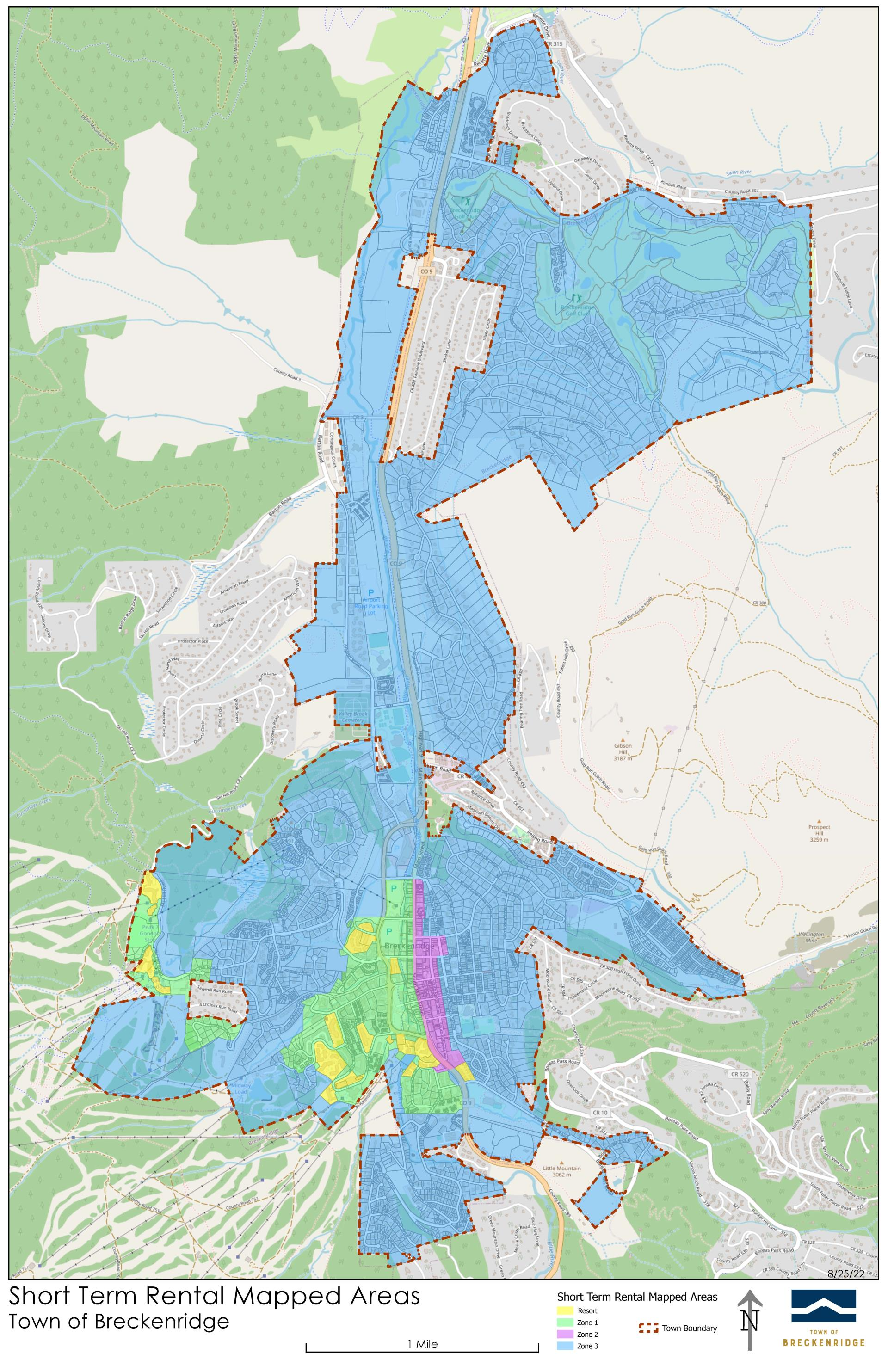
Breckenridge STR zone boundaries as adopted in 2022. Use the town's interactive GIS map to confirm any specific address.
Open — No Waitlist
Resort Properties Zone
1,719 active licenses
No cap. No waitlist.
Current license list | Apply
Properties built for resort use with front desk and on-site security. Fixed inventory, no artificial cap. The clearest licensing path in town. You are paying for that certainty in the purchase price.
|
Open — No Waitlist
Zone 1: Tourism Zone
1,221 issued / 1,680 allowed
459 licenses currently available
92% of properties eligible
Current license list | Apply
The sweet spot for most buyers right now. Real availability, no waitlist, and you are not paying full Resort Zone premiums. This is where I focus the search for buyers who need licensing certainty without an unlimited budget.
|
Waitlist Only
Zone 2: Downtown Core
130 licenses allowed
Full. No licenses available.
51% of properties eligible
License list and waitlist
At cap. You can buy here and join a waitlist, but there is no timeline. If rental income is the primary reason you are buying, Zone 2 needs a serious conversation before you write an offer.
|
No New Licenses
Zone 3: Residential Areas
390 licenses allowed at cap
1,008 held under legacy structure
618 over cap. No new licenses.
License list and waitlist
Only 10% of properties eligible, and the zone is 618 licenses above its own cap. Existing holders were grandfathered in. New buyers cannot get a license until significant attrition occurs, which is a long way off. As of the latest count, 231 buyers sit on the Zone 3 waitlist, and it is effectively frozen, since no new licenses are issued while the zone is over cap. Licenses have been leaving at roughly 85 per year recently, and at that pace it would take somewhere in the range of 7 to 15 years just to work off the surplus and get back under the cap, before the first new name on the list is even reached. Attrition also tends to slow as the remaining licenses grow scarcer, so a buyer joining the waitlist today should realistically plan on 15 or more years, and treat never, absent a Town Council rule change, as a live outcome.
|
The Zone 3 math is worth understanding: 1,008 active licenses against a 390 cap means the zone is 618 over its own target. Those are all grandfathered holders. A new buyer has zero path to a license until enough of them sell or let their license lapse. Based on historical attrition rates, that timeline is realistically 8 to 15+ years. And as the section below explains, rising STR revenue gives existing holders every reason to keep holding, which pushes toward the longer end. If you are looking at a Zone 3 property with strong rental history in the listing, remember: that history belongs to the current owner. It does not transfer to you.
View current license availability and waitlists (Town of Breckenridge) — figures above reflect December 2025 town report, updated quarterly
The License Does Not Come With the Property
This is the one that catches people off guard more than anything else. When a Breckenridge property sells, the seller's STR license is extinguished. It does not transfer. The new buyer applies fresh, under whatever zone status and availability exists at the time of closing.
A listing can show five years of Airbnb income history and four-and-a-half stars. That tells you what the current owner was able to do. It does not tell you what you will be able to do. Verify availability before you fall in love with the revenue projections.
What It Actually Costs to License an STR in Breckenridge
Getting the license is one thing. Keeping it costs money every year. There are two fees: the annual accommodation unit license fee based on bedroom count, and a separate regulatory fee that the town uses to fund workforce housing programs.
Annual Regulatory Fee
$756 per bedroom per year. That is not a typo. A three-bedroom unit costs $2,268 annually in regulatory fees alone before you pay the license fee, property management, or anything else.
| Unit Size |
Annual Regulatory Fee |
| Studio |
$756 |
| 1 Bedroom |
$756 |
| 2 Bedrooms |
$1,512 |
| 3 Bedrooms |
$2,268 |
| 4 Bedrooms |
$3,024 |
Primary residence exemption: If the unit is your primary residence and you rent it no more than 21 days per year, the regulatory fee does not apply. Narrow exemption, but worth knowing.
Source: Town of Breckenridge: Accommodation Unit Licensing and Fees
Source: Town of Breckenridge: STR Licensing FAQs
Taxes
On top of the fees, every Breckenridge STR owner is required to collect and remit:
- 3.4% Public Accommodation Tax
- 2.5% Town of Breckenridge sales tax
If you book through Airbnb or VRBO, they handle the collection and remittance automatically. If you take direct bookings outside those platforms, that falls on you to remit through MuniRevs.
Source: Town of Breckenridge: Accommodations Tax
Responsible Agent Requirement
Every licensed STR needs a designated Responsible Agent, either you or a property management company, who is available 24/7 and can respond to any complaint at the property within 60 minutes. If you are not local, this means hiring someone who is.
The HOA Can Overrule Everything
I have seen buyers do all the right zone research, confirm a license is available, and then discover the HOA prohibits short-term rentals entirely. It happens more than you would think, especially with condos and townhomes, which are also the properties most buyers are looking at for STR use.
Before you go under contract on anything, pull the HOA documents and look for:
- Rental restrictions or outright prohibitions
- Minimum stay requirements
- Occupancy limits that are stricter than the town's
- Guest parking and check-in policies that make logistics difficult
- Any pending rule changes that could affect rental use after closing
Rental history in a listing description tells you what the current owner was allowed to do under the current HOA rules. Both of those things can change.
What I Actually Look at Before Recommending an STR Purchase
When a buyer tells me rental income is part of the plan, the listing description is genuinely the last thing I focus on. Here is what matters:
- Is this property actually inside the Town of Breckenridge, or is the mailing address doing misleading work?
- If it is not in town limits, which jurisdiction controls it and what do those rules look like?
- What zone is it in, confirmed on the town's GIS map, not just assumed from the neighborhood?
- Is a license available right now, and what does availability look like over the next year or two?
- What do the HOA documents actually say, and when were those rules last updated?
- Does the layout, parking, and access work for rental guests or just for owners?
- Would this property still make sense if you could never get an STR license?
That last question is the most important one. I have had buyers go under contract before fully thinking through the STR picture. It is an avoidable mistake. The buyers who do best here are the ones who want the property regardless of the rental income, and treat the rental income as a bonus rather than a requirement.
The Unintended Consequences Nobody Wants to Talk About
The town's theory is straightforward. Fewer licensed STRs over time means more housing available for local workers. The mechanism is attrition. Owners sell or let licenses lapse, the total slowly drops, everybody wins.
Here is the problem with that theory.
Breckenridge visitor demand is not going anywhere. The mountain, the brand, the Main Street, the summer crowds. None of that is shrinking. So when you reduce the supply of licensed rental nights without touching demand, basic economics takes over. Occupancy goes up. Nightly rates go up. Revenue per licensed unit goes up.
Now the owners who held onto their licenses are making more money than before the regulations passed.
And because their licenses vanish the moment they sell, they have every reason to keep holding. The attrition the town is counting on to hit its targets gets slower as returns get better. The policy is eating its own homework.
It gets better. Resort Zone and Zone 1 properties with clean licensing paths now command a premium over everything else in town. That premium does not stay politely contained to its own zone. It pulls the whole market up. Including the Zone 2 and Zone 3 properties that can never get a new license. Their values rise anyway just from being in Breckenridge.
So the net result of a policy designed to create affordable workforce housing may be: modestly fewer STR units over a very long timeline, meaningfully higher property values across the board, and a local workforce that is no closer to being able to afford a place to live.
Whether that outcome was obvious to anyone paying close attention when the zone lines were being drawn is a question worth sitting with.
Is Breckenridge Still a Good Airbnb and Vacation Rental Market?
Yes, for the right property in the right zone. The visitor demand is real and durable. The skiing, the Main Street, the year-round events. None of that changed because licensing got complicated. What changed is that you can no longer assume every property in town works the same way as a rental. The zone determines that now.
Breckenridge makes sense if:
- Personal use matters alongside rental income
- You are buying in the Resort Zone or Zone 1
- Long-term appreciation in a premier resort town is the real goal
- You want a property that works for owners and guests
- You are willing to do the zone and HOA homework before making an offer
|
It gets complicated if:
- Maximum rental income is the whole point
- The property is in Zone 2 or Zone 3
- You need a guaranteed license regardless of zone
- You want a low-friction investment with no regulatory complexity
- You are projecting income based on the seller's rental history
|
Comparing Breckenridge against Keystone, Frisco, Dillon, Silverthorne, Blue River, or Copper Mountain? Start here: Summit County Short-Term Rental Regulations.
Common Questions
Can I list a Breckenridge property on Airbnb or VRBO?
Yes, if the property is in the Resort Zone or Zone 1 and a license is available. Zones 2 and 3 are closed to new buyers right now. Any rental under 30 consecutive days requires a valid Town of Breckenridge accommodation unit license regardless of platform.
Does the STR license transfer when a property sells?
No. Full stop. The license is extinguished at closing. Every new buyer applies fresh under whatever availability exists at that time. Strong rental history in the listing is not a guarantee you can get a license.
How do I find out which zone a property is in?
Use the town's interactive STR zone map or send me the address. I confirm zone status on every STR-intended purchase I work on.
What does it cost to license a Breckenridge STR?
$756 per bedroom per year in regulatory fees alone. A three-bedroom unit is $2,268 annually before the separate license fee. A primary residence exemption applies if you rent no more than 21 days per year.
What taxes do Breckenridge STR owners pay?
3.4% Public Accommodation Tax plus 2.5% Town sales tax on all STR revenue. Airbnb and VRBO handle this automatically for platform bookings. Direct bookings are your responsibility to remit through MuniRevs.
Can an HOA kill my STR plans even if the town says I can rent?
Absolutely. HOA rules layer on top of town permissions and can be more restrictive. Always pull the CC&Rs and check for rental restrictions, minimum stay requirements, and occupancy limits before making an offer. I have seen buyers get surprised by this after going under contract.
Does a Breckenridge address always mean Breckenridge rules apply?
No. Some properties with Breckenridge mailing addresses fall under unincorporated Summit County or the Town of Blue River. Confirm jurisdiction with the Summit County GIS tool before assuming anything.
What is a Responsible Agent and do I need one?
Yes, it is required. Every licensed Breckenridge STR needs a designated Responsible Agent, either you or a management company, available 24/7 and able to respond to any complaint at the property within 60 minutes. If you are not local, budget for property management.
Working Through a Breckenridge Purchase?
If rental income is any part of your plan, the zone and licensing picture needs to be sorted out before you start narrowing your search, not after you are already emotionally invested in a specific property.
I have worked Summit County for years and have done transactions across all four Breckenridge STR zones. I know which buildings have HOA restrictions that never make it into listing descriptions, which zones have real availability right now, and what the licensing process actually looks like from day one.
Tucker Zimmerman
Associate Broker, Slifer Smith & Frampton
303-907-9129 (call or text)
TZimmerman@SliferSummit.com
SoldInSummit.com
Disclaimer: Short-term rental rules, license availability, zone caps, HOA restrictions, fees, taxes, and enforcement policies change. This page is for general informational purposes only and is not legal, tax, or financial advice. Always verify current rules directly with the Town of Breckenridge Finance Department, Summit County Community Development, the applicable HOA, and qualified legal and tax professionals before making a purchase decision. License availability figures are published quarterly by the Town of Breckenridge and do not update in real time. Tucker Zimmerman is a licensed Colorado real estate broker with Slifer Smith & Frampton.


